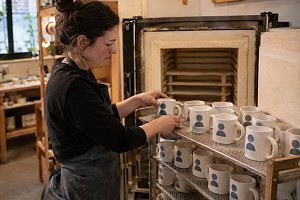
Mugs and cups are among the promotional items that people actually use. However, unlike a pen or a pad, they are washed every day in hot water with detergent, often in the dishwasher. This is where the difference between cheaper and more durable printing becomes apparent. A logo that fades or peels off after a few months will not benefit your brand. Therefore, when choosing, start by asking where and how often the mug will be used.
You will most often encounter four processes with mugs and cups:
For an overview of techniques for other materials, see the article Printing promotional items - which technique is suitable for which material .
When firing, the motif is most often screen-printed onto transfer paper as a decal. This is transferred to the mug and the object is fired at a temperature of the order of hundreds of degrees. Slovak manufacturers state a range of 550-800 °C. The color is thus incorporated into the glaze and becomes part of the surface.
The result is resistant to abrasion and dishwasher, which is why firing is the best choice for mugs for a company kitchen, café or hotel. The limitation is the number of colors. Firing is especially suitable for logos with one or several solid colors, less so for photographs and color gradients.
Sublimation only works on mugs that have a special polymer coating. The motif is printed on transfer paper and transferred to the coating in a press at a temperature of around 180-210 °C. Thanks to this, it can handle full-color printing, photos, transitions and motifs around the entire mug.
Sublimation is used on light-colored mugs because the white color is not printed, it is created by the substrate itself. In addition to ceramics, there are also sublimation thermo mugs made of stainless steel with full-color printing. Dishwasher durability depends on the quality of the coating, so always follow the manufacturer's instructions for sublimated mugs. Hand washing will extend the life of the motif.
Engraving does not use paint, so it does not have to be wiped off or faded. It is typically used on stainless steel thermos mugs and tumblers, where it creates a bright and elegant logo. On ceramics, it is only possible with mugs with a special surface designed for engraving. For example, a mug with a soft rubberized surface and a colored interior, where the engraved logo matches the color of the inside.
Engraving is single-color and the resulting shade is determined by the material, not the color of the logo. It is therefore suitable for discreet logos and inscriptions, less so for colorful motifs.
| Technology | Suitable material | Color | Washing resistance | When to choose it |
|---|---|---|---|---|
| Print with burn-in | ceramics, porcelain, glass | one or several solid colors | very high | everyday use, office, gastro |
| Sublimation | mugs with sublimation coating | full color, photograph | according to the quality of the coating | small series, personalization, photography |
| Laser engraving | stainless steel, ceramic with special surface | solid color, material shade | high, colorless | thermos mugs, premium gifts |
| Printing without baking | ceramics, glass, plastic | saturated colors | lower, preferably hand wash | promotions, short-term campaigns |
The statement "dishwasher safe" is not equally accurate for every mug. In Europe, resistance is tested according to the EN 12875-1 standard. This describes a reference test in which the object is subjected to repeated washing cycles in a test dishwasher, but does not itself determine how many cycles a product must withstand. Therefore, a specific indication of the number of cycles is more useful.
An example from the offer is a ceramic coffee mug, which, according to the manufacturer, can withstand at least 125 washing cycles, including printing, in accordance with the EN 12875-1 standard. For other models, on the other hand, you will find the warning "hand wash only" or "not dishwasher safe" in the description. This applies, for example, to some mugs with a matte surface or with a lid. If the mug will be used in a kitchen with a dishwasher, check this information before ordering.
There are several basic materials in the range of printed mugs . Each of them is suitable for a different technology:
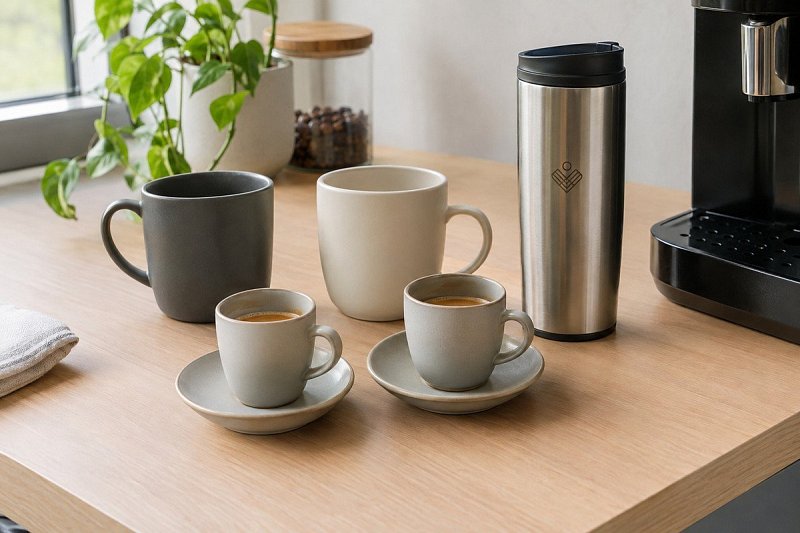
Espresso and cappuccino cups are smaller, so they need a smaller and simpler logo. Sets of cups and saucers are suitable as gifts for partners, as are tea gifts with a teapot and a cup. If you are solving the problem of choosing a type of mug according to the target group, the article Mug and coffee: the apparent detail that sells will also help you.
On ceramics and porcelain, the most durable printing is with firing, in which the color combines with the glaze. On stainless steel thermo mugs, laser engraving is very durable.
Yes, sublimation is the best option. However, it only works on mugs with a sublimation coating and on a light background.
It depends on the quality of the coating and the manufacturer's instructions. Hand washing will extend the life of the motif.
It is a European test method for the resistance of objects to washing in a dishwasher. The number of cycles that the product has withstood is stated by the manufacturer, for example 125 cycles.
Simple, with fewer colors and no fine details. A more modest logo or short inscription works better on a small area.
We are on Facebook


