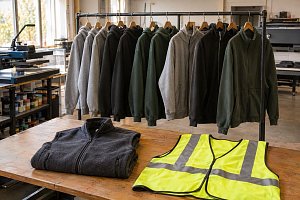
Jackets and sweatshirts are among the most visible pieces of corporate clothing. Employees wear them on their way to work, on construction sites, during deliveries and at events, and the logo is seen by many more people than if it were a T-shirt hidden under a sweater. At the same time, they are more expensive and complex textiles, where the wrong choice of material or technique is only visible after the first season. We will introduce you to how to choose the type of clothing according to its use and how to mark it with a logo so that it lasts.
When choosing a jacket, start by asking where and in what weather people will wear it. In the range of custom printed jackets, you will find several basic types:
For office teams and salespeople, a softshell is the most versatile choice. For technicians, couriers and construction workers, a combination of a waterproof and fleece jacket is worth considering.
Grammage is the weight of the fabric per square meter and, in the case of sweatshirts, it is a good indicator of thickness and warmth. A classic hoodie, for example, has a weight of 280 g/m² and is made from a blend of 50% cotton and 50% polyester. Such a blend is pleasant to wear and shrinks and shrinks less after washing than pure cotton.
The range of sweatshirts and vests with logos also includes sweatshirts made of organic cotton with a share of recycled polyester, lighter sweatshirts made of microfleece weighing around 200 g/m² or fleece vests. Sweatshirts also differ in cut - with a hood, with a zipper, without a zipper or with a stand-up collar and a quarter-zip. A sweatshirt with a hood looks informal, a model with a stand-up collar also fits into corporate attire when in contact with customers.
| Clothing | Typical material | When is it suitable? | Suitable logo marking |
|---|---|---|---|
| Softshell jacket | polyester, often with elastane or microfleece | spring, autumn, office and outdoors | embroidery or transfer at low temperature |
| Waterproof jacket | nylon, taped seams | working outside, rain | transfer that does not pierce the membrane |
| Insulated jacket | polyamide, polyester wadding | winter, working outside all day | transfer or embroidery on a flat surface |
| Fleece jacket and vest | 100% polyester | dry weather, midlayer | embroidery |
| Sweatshirt | cotton with polyester | all year round, interior and leisure | screen printing, DTF transfer, embroidery |
| Reflective vest | fluorescent polyester | transport, warehouses, construction | 399px; text-align: center;">screen printing or transfer outside reflective stripes
The table is for guidance only. We always verify the specific technique by model, as even two softshell jackets can differ in surface finish.
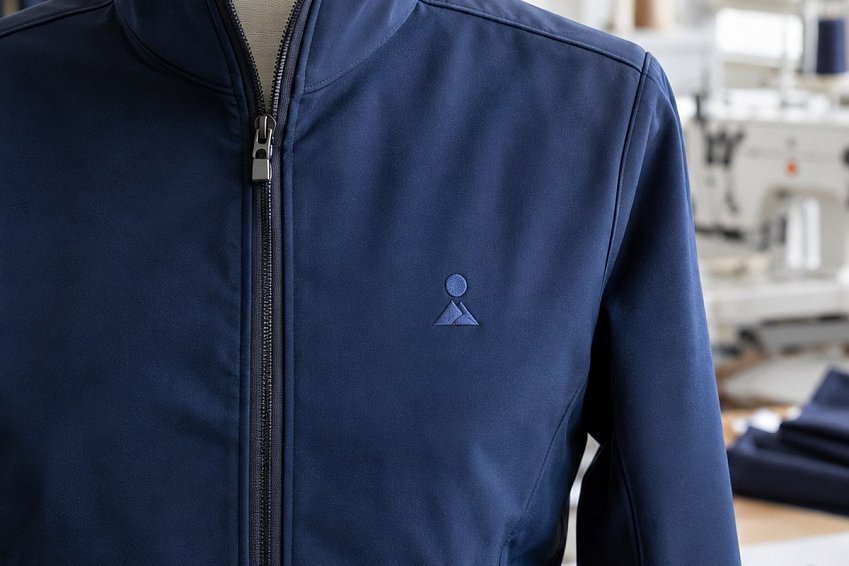
The most common location is the left side of the chest. The logo is visible there during personal contact and does not interfere with zippers or pockets. A larger motif or inscription belongs on the back, preferably in its upper part under the collar, where it is visible even from a distance. The sleeve is additionally used, for example for a website address or a smaller brand.
For jackets, be careful of seams, zip pockets and quilted chambers of insulated models. Prints and embroidery over seams do not hold as well as on a flat surface, and on quilted jackets the logo may curl. For hoodies, keep in mind that the hood will cover part of the back, so place the motif lower on the back.
Thicker materials are ideal for embroidery, which is why it is most often embroidered on fleece jackets, vests and sweatshirts. The logo can also be printed on sweatshirts made of cotton and polyester using screen printing or DTF transfer, which is especially worthwhile with a larger motif on the back.
For softshell and technical jackets, the surface finish and the material's sensitivity to heat must be taken into account. Screen printing with a high curing temperature can damage the material with a membrane, so a transfer with a lower pressing temperature is used for large motifs. Embroidery is common on softshell without a membrane, but with waterproof jackets the needle pierces the membrane. For a more detailed comparison, see the article Print or embroidery on t-shirts and corporate textiles?
Reflective vests are a popular logo carrier in transportation, warehouses and construction sites. The range of reflective promotional items includes vests for adults and children, which are printed using screen printing or transfer printing.
For vests that are certified protective clothing, the standard EN ISO 20471 applies, which replaced the older standard EN 471 in 2013. The standard specifies the minimum area of fluorescent and reflective material according to class - for class 2 it is 0.50 m² of fluorescent and 0.13 m² of reflective material. The logo must therefore not overlap the reflective stripes and cannot be so large that it reduces the visible fluorescent area below the limit of the given class. A suitable location is the chest or upper back between the reflective stripes.
Most models are made in men's and women's cuts, some also in unisex or children's versions. Women's cuts are fitted, so it is worth offering them to the women in the team separately, rather than ordering unisex sizes for everyone. With jackets, also take into account that they are worn over a sweater or sweatshirt, so some employees choose a size larger.
For larger orders, it is practical to collect sizes using a simple table or form, and if unclear, order a sample. If employees wear jackets and sweatshirts, choose the same color shade and the same logo placement to make the clothing look uniform. For work and corporate clothing, this way, the jacket, sweatshirt, and T-shirt can be matched into one whole.
Most often softshell. It is breathable, windproof, water-repellent and suitable for the office and for working outdoors most of the year.
Technically yes, but the needle punctures pierce the membrane and the jacket can leak water at the embroidery site. Therefore, for waterproof jackets with a membrane, a transfer that does not pierce the material is more suitable.
A regular hoodie is around 280 g/m², making it a warm and durable choice for year-round wear. Lighter microfleece hoodies are around 200 g/m².
Yes, both printing and embroidery are possible. However, the logo must not cover the reflective stripes and, for certified vests, must not reduce the fluorescent area below the minimum required by the standard. EN ISO 20471.
Most often on the left side of the chest, a larger motif on the upper back. Avoid seams, zip pockets and quilted chambers of insulated jackets.
We are on Facebook


