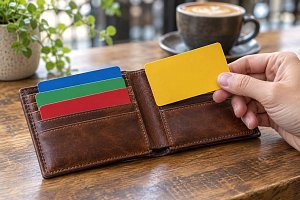
A café loyalty card, a fitness center membership card, an employee ID card, or a gift certificate all have one thing in common: you carry them with you for years and see the brand every time you open your wallet. Therefore, plastic cards with your own print are not only a technical aid, but also a brand carrier. However, the result depends on whether you choose the right technology, material, and security features before you order.
A card with a custom motif can have a wide variety of uses. The most common uses are:
If you're building a loyalty program, it's worth linking the card to other items that customers receive upon sign-up. For more on how branded items strengthen customer relationships, see the article Captivate Customers' Hearts .
Most loyalty, membership and bank cards are in the ID-1 format, which is specified by the ISO/IEC 7810 standard. The card measures 85.60 x 53.98 mm, has a nominal thickness of 0.76 mm, and has rounded corners. This makes it fit in any wallet and works in common readers, printers and holders.
A custom shape is possible, but is more suitable for key chains or promotional cards. If the card is to be read in a terminal or inserted into a reader, stick with the standard format.
The technology determines how the card will be used at the cash register, at the entrance or in the application. The range of plastic card production with custom printing includes classic laminated cards, magnetic stripe cards, chip and memory cards, contactless cards and ecological plastic cards.
| Technology | How it works | What is it good for? |
|---|---|---|
| Classic laminated card | Printing without data carrier, or with barcode | Loyalty cards that the cashier scans, gift cards, VIP cards |
| Magnetic stripe | Data is written to the strip and read by swiping it over the reader | Loyalty and membership systems that already work with magnetic readers |
| Contact chip | The memory chip is read after being inserted into the reader | Cards that store more data or credit |
| Contactless chip | The card communicates with the reader over a short distance without contact | Building entrance, attendance, season tickets, locker rooms |
There are two types of magnetic stripes. A high-coercivity stripe (HiCo, around 2,750 Oe) is more resistant to accidental erasure and is therefore used for cards that are intended to last for years. A low-coercivity stripe (LoCo, around 300 Oe) is easier to write on and erase and is therefore more suitable for short-term cards, such as hotel keys.
Contactless cards used in access and time attendance systems most often operate at a frequency of 13.56 MHz according to the ISO/IEC 14443 standard and are read at a distance of several centimeters. Therefore, before ordering, ask your system supplier for the exact chip type so that the new cards will work with current readers.
In addition to the printing itself, elements can be added to the card that make it easier to work with or more difficult to counterfeit:
For membership and company badges that are worn throughout the day, it's also worth considering how they'll be worn. Logo-printed lanyards or a badge holder with a clip that clips to clothing are a good choice.
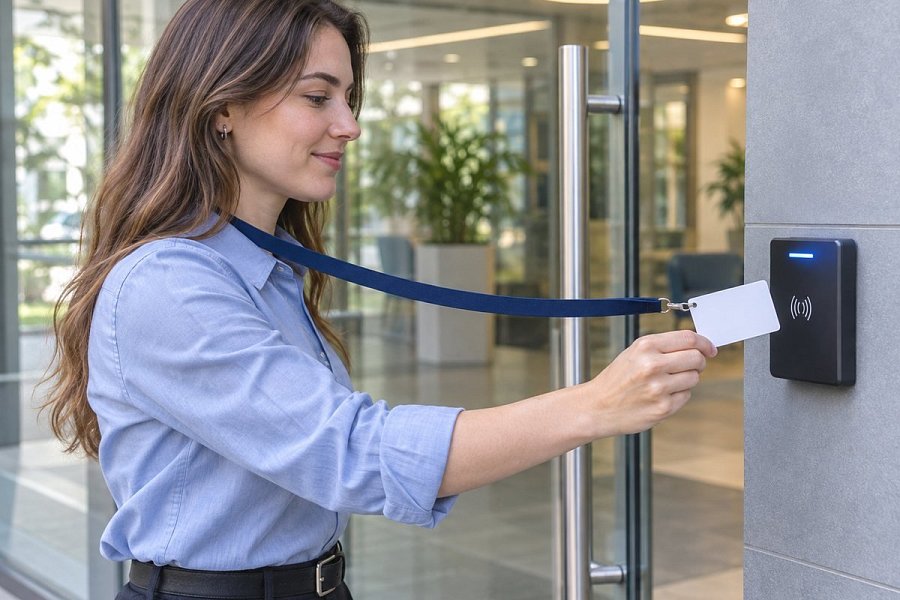
There is little space on the card, so the rule of “less is more” applies when designing. A logo, program name, and one distinctive element are more important than a lot of text.
The minimum quantity for the production of plastic cards with custom printing is 200 pieces and production usually takes 12-14 working days. This includes time for design, graphic approval and possible samples.
If you are launching cards in conjunction with a new loyalty program or business opening, order them at least a month in advance. This will give you some time to adjust the graphics and test the cards in a cash register or entry system. You can also find similar custom products in the Creative promotional gifts, custom-made category.
A loyalty card is used for repeated purchases and collecting benefits, so the customer uses it for a long time. A gift card has a set value and is usually no longer used after it is used up. Therefore, a more durable design is more worthwhile for a loyalty card.
Yes. Cards can be customized with a barcode, embossed number or holder name. You provide the data for each card in a table along with the graphic.
It depends on the type of reader. For both magnetic stripe and contactless chip, request exact specifications from the system supplier and test the cards before placing a large order.
When producing plastic cards with your own printing, the minimum quantity is 200 pieces. The final solution depends on the chosen technology, elements and printing.
Yes, we also offer eco-friendly plastic cards. We will specify the specific material and its properties before you order.
We are on Facebook


