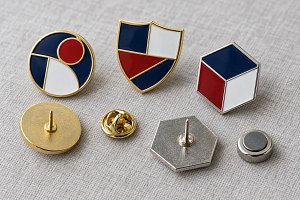
A badge is one of the few promotional items that people carry around. That's why it's subject to stricter standards than a pen or a bag: it must look neat, not easily scratched, and not get lost on the first move. Three things are crucial when choosing a badge - what the badge will be made of, what technique will be used to transfer the logo, and how it will be attached. If you match these three choices with who and where the badge will be worn, the result will last for years.
When it comes to custom badges, you'll most often come across four groups. They differ in appearance, durability, and the logo details they can handle.
| Badge type | Material and production | Appearance | When is it suitable? |
|---|---|---|---|
| Metal enameled | metal base with colored enamel in limited areas | embossed or smooth, looks valuable | corporate lapel pins, awards, anniversaries |
| Metal with print and resin | metal base, print and protective resin layer | smooth, accurately renders color transitions | logos with fine details and color gradients |
| Plastic in its own shape | solid plastic, print covered with resin on the front | light, colorful | events, campaigns, team badges |
| Button (pancake) | metal base with paper with graphics under protective foil | round or simple shape | festivals, camps, large-scale distribution |
You should choose the promotional metal badges offer when the badge is to represent the company in the long term. Plastic badges and buttons are suitable where the number of pieces and the expressiveness of the colors are decisive.
Metal enamel badges are most often made from an alloy of zinc or iron. The motif is pressed into the metal and the resulting depressions are filled with colored enamel. The difference lies in how the enamel is applied and how the surface looks.
If the logo contains color gradients, photography, or very thin lines, enamel will not capture them accurately. In that case, a resin-overlaid print is a better choice.
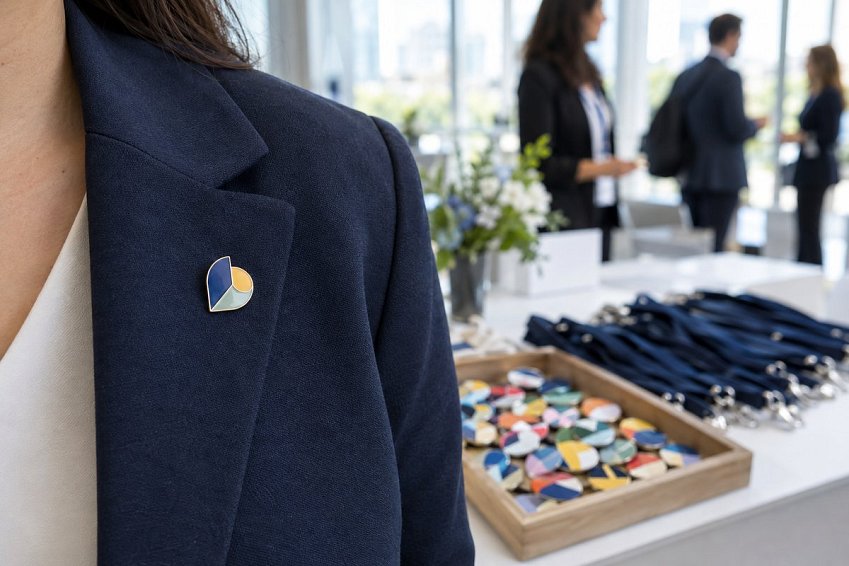
Epoxy - resin badges in their own shape have the print covered with a transparent layer of resin. This protects the motif and gives it a slightly convex, shiny appearance. Digital printing can handle color transitions and small details, so it is suitable for more complex logos. Colors are printed in CMYK, so expect a slight deviation when using an exact Pantone shade.
Custom-shaped plastic advertising badges are made of solid plastic and the print on the front is also protected by resin. You determine the shape and size yourself and we can prepare the graphics for you. They are lightweight, so they do not pull on thin fabric, and are suitable for campaigns, events or team marking.
Fastening is often left to the last detail, but it is the key to whether the badge will be worn. Improper fastening will damage the fabric or cause the badge to be lost.
A simple, no-piercing alternative is a magnetic badge with your own design .
Advertising badges - buttons are made of metal and plastic and come in various shapes: round, oval, square, rectangular, heart-shaped, hexagonal or triangular. In addition to being fastened with a pin, they can have a magnet, a lanyard, a document clip or a key ring.
The button can also serve another function. It is made with a mirror, a bottle opener, a reflective or fluorescent design, or a display cleaner. Such a badge then does not end up in a drawer, but is used.
With badges, the substrate matters more than with other items because the logo is reduced to a few centimeters.
What is the difference between a badge and a button? A button is usually a round badge with graphics on paper under a protective film. A custom badge can be any shape and is made of metal, enamel, resin or hard plastic.
Which badge is the most durable? A metal badge with hard enamel. Its surface is smooth and polished, so it resists scratches better than soft enamel or printing.
Can a badge be made in the shape of a logo? Yes. Metal, resin and plastic badges are made in a custom shape according to the supplied graphics.
Which fastener won't damage clothing? Magnetic. The badge holds without puncturing the fabric, so it's suitable for delicate materials and clothing that is changed frequently.
Can you help with badge design? Yes. Send us your logo and tell us where the badge will be worn. We will suggest suitable material and fastening, and prepare a visualization and a price quote.
We are on Facebook


